Flowershow — Product Assessment
Flowershow — Product Assessment
April 2026
Author: Aleksandra Rubaj
Executive summary
Flowershow is showing clear signs of product traction, but not yet consistent product maturity.
The strongest signal in the current data is that people who make it into the product often do reach first value. Once users get from the homepage to signup, conversion through signup, site creation, and first site visit is relatively solid. This suggests the core product experience is already working reasonably well for motivated users.
The biggest weakness is top-of-funnel conversion. Only a small share of homepage visitors continue to signup, making the marketing site the main bottleneck in the user journey. In practice, Flowershow appears better at serving interested users than at convincing new visitors to start.
The second major weakness is retention. Many users publish/sync or configure a site once, but relatively few return in later months to do it again. This suggests Flowershow is currently stronger as a “publish once” or occasional-use tool than as a recurring workflow for most users, or that it doesn't meet users' needs, so they never use it again after trying it out.
In terms of workflow adoption, the clearest winners are Obsidian publishing, GitHub sync, and simple web/dashboard upload. Recent data especially points to Obsidian and low-friction browser-based publishing as strong directions. By contrast, CLI and anonymous drag-and-drop currently appear marginal and do not seem to justify major strategic emphasis at this stage.
Recent growth in March 2026 shows that awareness can be generated quickly, especially through launch and community channels. Product Hunt drove a large spike in visits, signups, and active users, while Google (not sure how…), Reddit, and the Obsidian forum show that search and community discovery are also meaningful channels. However, acquisition is still somewhat uneven and attribution remains incomplete, with a large amount of traffic classified as direct.
Overall, the data suggests that Flowershow’s best near-term opportunity is not building more edge workflows, but improving performance in the areas already showing evidence of demand: clearer homepage messaging, stronger activation from qualified traffic, continued investment in Obsidian and simple publishing flows, and better retention after first use.
In short: Flowershow already has real pull, but it needs better conversion and stronger repeat usage to turn that pull into durable growth.
1. What this document should answer
This assessment is meant to answer:
- How is Flowershow doing right now?
- Who is using it?
- Where are users coming from?
- What are they actually using?
- What seems to be working?
- What seems not to be working?
- What should we focus on next based on the data?
2. Key product metrics snapshot
Total users
2026-03-31: 1499
Paid users
2026-03-31: 11
Sign ups
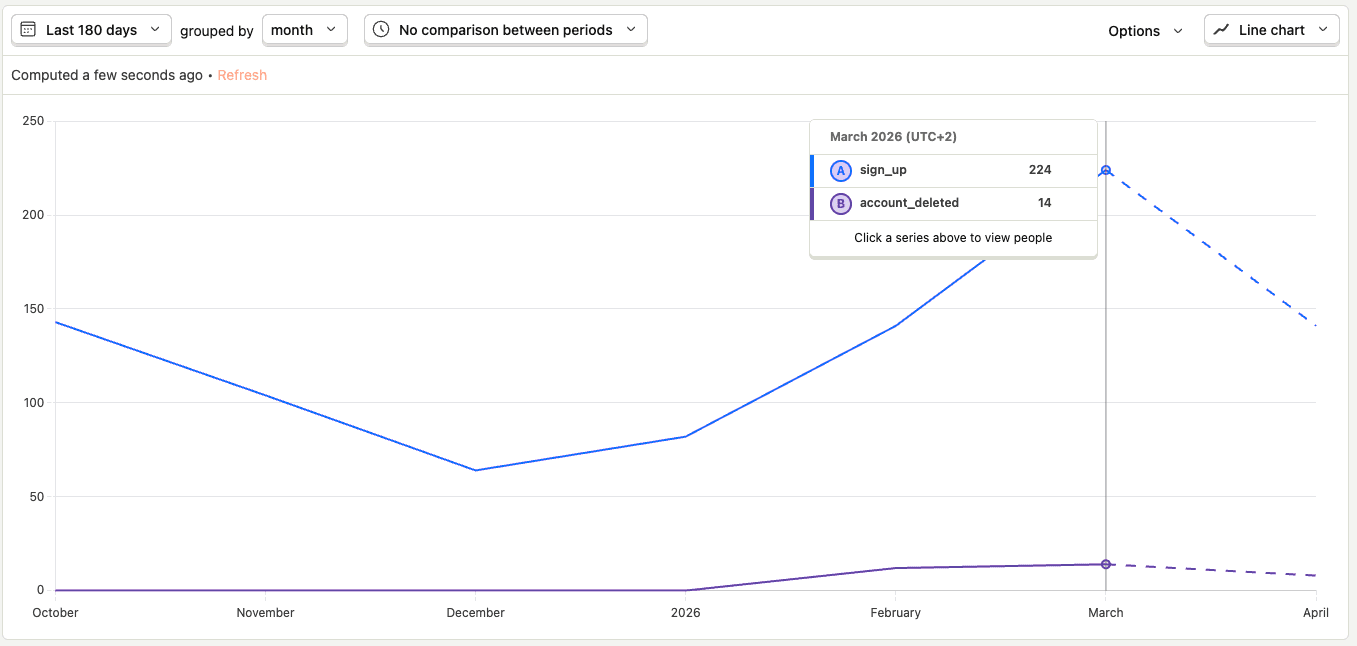
https://eu.posthog.com/project/85675/insights/JpMzOJO0
What the data tells us
Sign-ups have been growing strongly, with a notable spike in March 2026 (224 sign-ups) – the highest month in the period (influenced by Product Hunt Launch on 25.03.2026). After a slow end of 2025 (dropping to 64 in December), there's been a clear recovery and acceleration into early 2026.
Account deletions only started appearing in February 2026 – none were recorded before that (it wasn't possible to delete an account before). Since then, they've been relatively low (8–14/month) compared to new sign-ups, which is a healthy ratio. The churn rate (deletions vs. sign-ups) has been around 6–8%.
MAU (Monthly Active Users)
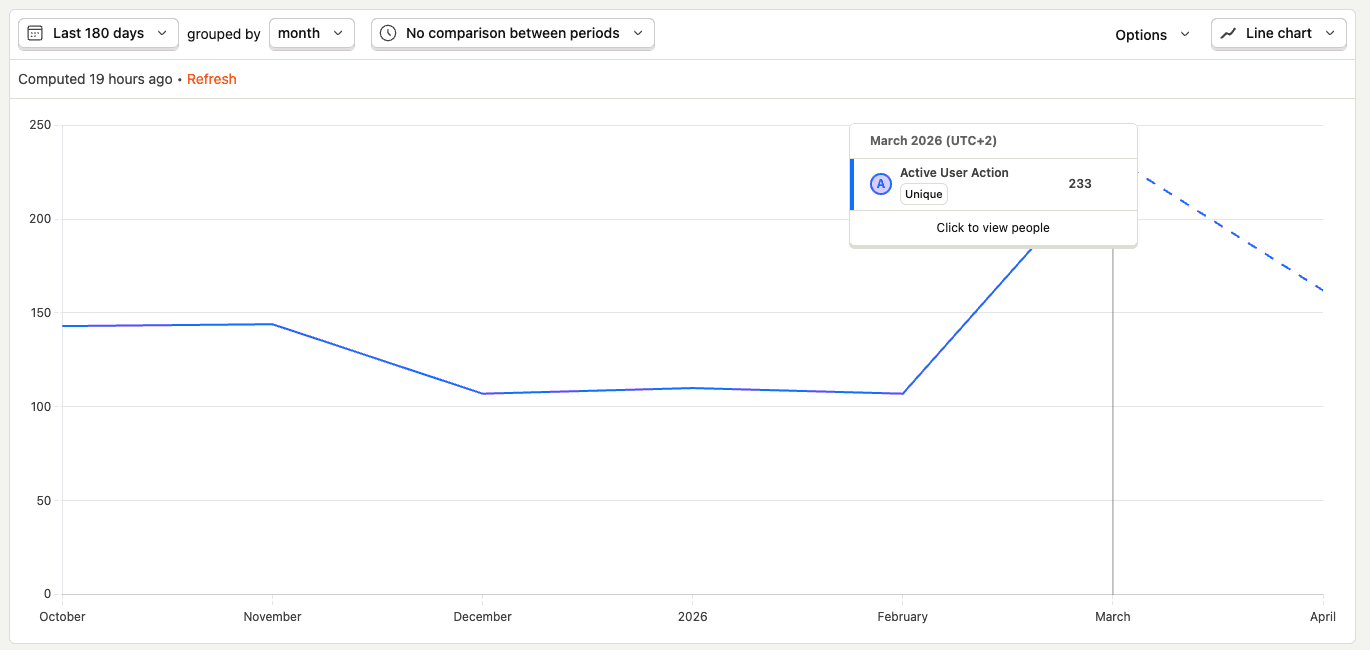
https://eu.posthog.com/project/85675/insights/EPCYEYwZ
Active User Definition: a registered user is “active” in a given period if they perform ≥1 core value action within that period that shows they’re maintaining or publishing their site.
Core value actions:
- Site created
- Site configuration changed in the dashboard
- Content published
What the data tells us
There are two distinct phases visible:
Stable plateau (Oct 2025 – Feb 2026): MAU hovered in a tight range of 107–144, suggesting a relatively static user base with consistent engagement but little growth.
Strong breakout in March 2026: MAU jumped to 244 – a +128% increase compared to February. This is a significant spike and tied to a Product Hunt launch on 25.03.2026.
3. Acquisition: where users come from
First-time visitors to flowershow.app/ (the homepage), broken down by referring domain, over the last 180 days. This captures new visitor acquisition and where they came from.
https://eu.posthog.com/project/85675/insights/GufIw0Nc
https://eu.posthog.com/project/85675/insights/odxGNkVH
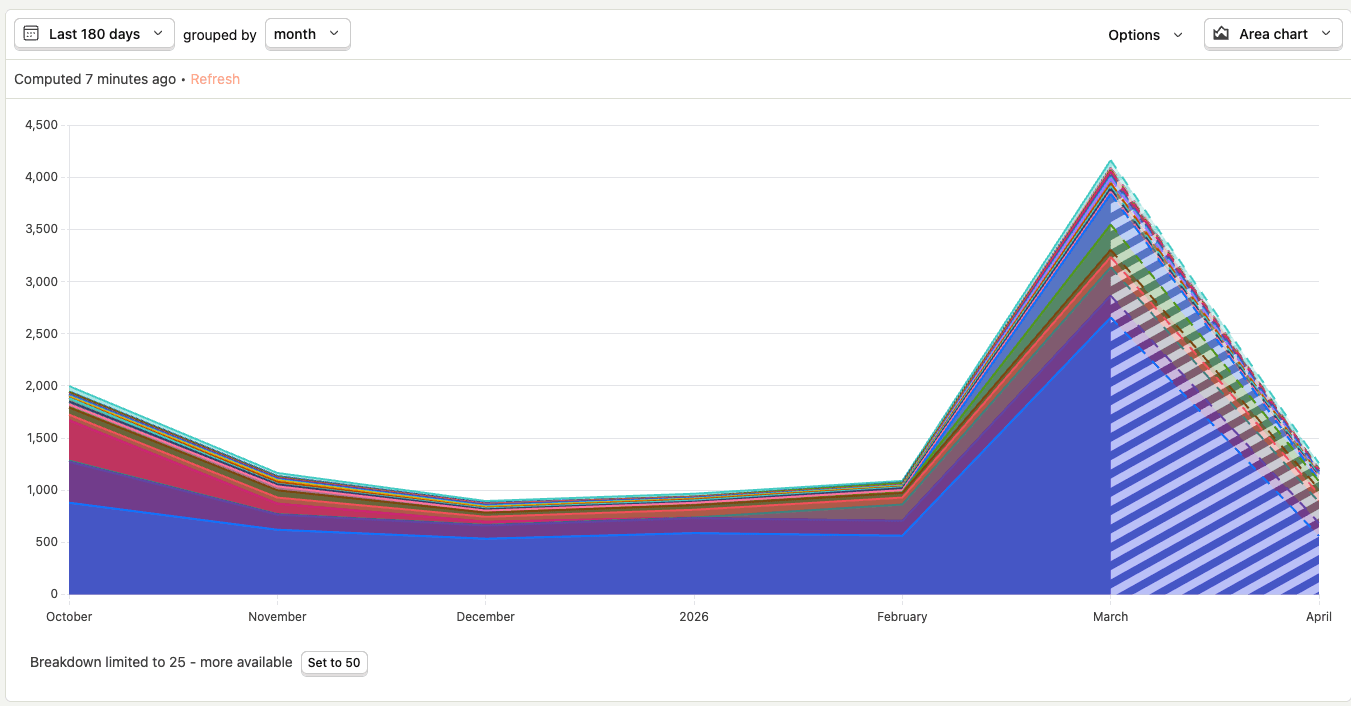
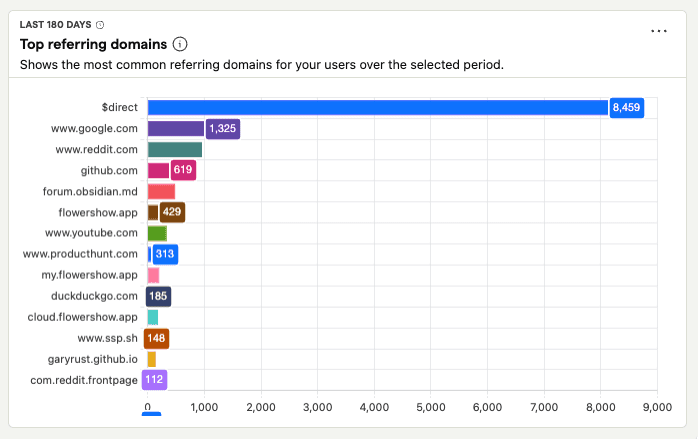
Total first-time visits jumped to roughly 4,160 in March – compared to a baseline of ~900–1,200/month in the preceding months. This was influenced by the Product Hunt launch on 25.03.2026.
Other notable patterns
garyrust.github.ioin October 2025 sent 387 visitors – almost as much as Google that month. Someone's GitHub Pages site featured Flowershow prominently and drove significant discovery.- Google is consistently the second-largest source (~123–392/month), indicating steady organic search presence.
- Reddit has been growing as a source since February 2026 (157 visits), before the March spike – suggesting community-driven interest was building ahead of the launch.
- Direct traffic dominates every month, which is expected for a known tool, but the March direct spike is unusually large – likely driven by newsletter sends, email campaigns, Product Hunt spillover, or social shares.
- Obsidian forum (
forum.obsidian.md) sends consistent traffic every month (48–99 visits), reflecting strong relevance to the Obsidian/digital garden community.
Acquisition summary
What seems strongest
- Product Hunt and launch-related distribution can create very large awareness spikes very quickly.
- Organic search already brings a meaningful baseline of discovery even before dedicated SEO work is mature. How is this even possible, we can't even find Flowershow in Google search ourselves 😅
- Community channels are relevant: Reddit and the Obsidian forum both send qualified traffic.
- Direct traffic is very large, which suggests some existing awareness, word of mouth, repeat visitors, and traffic from untagged campaigns.
What seems weaker / riskier
- Acquisition is still highly spike-driven rather than steadily compounding.
- A lot of “direct” traffic is unattributed, so we do not fully know what is driving discovery.
- Some meaningful traffic sources appear one-off and not repeatable yet (for example the GitHub Pages mention in October).
What this suggests Flowershow can generate attention, but acquisition is not yet predictable. The strongest evidence points to launch/community/search channels working better than broad passive homepage discovery alone.
4. Activation: do users reach the core value?
Activation: user signs up and publishes their first site.
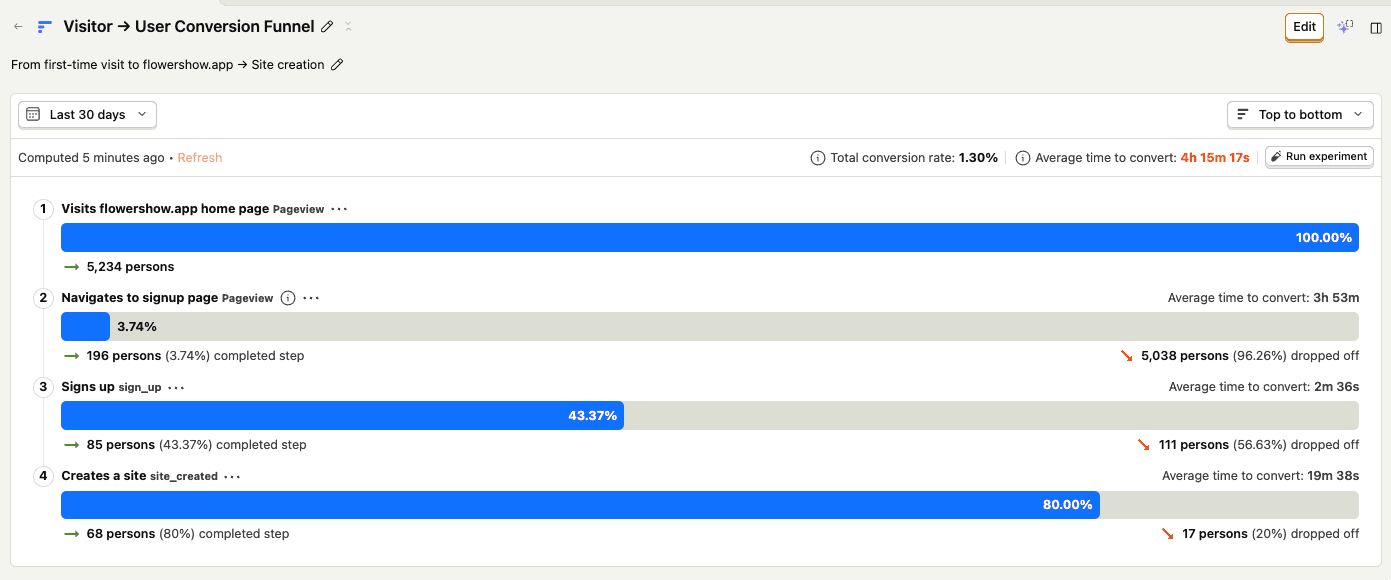
What the funnel tracks
This funnel measures how well Flowershow converts anonymous visitors into active users, across 5 steps:
- Visits flowershow.app – lands on the main marketing site
- Navigates to signup page – goes to
cloud.flowershow.app/login - Signs up – completes registration
- Creates a site – takes the core activation action
- Visits their site – reaches the first real publishing outcome
What stands out
- The biggest drop is at step 1 → 2: only about 3.4% of homepage visitors click through to the signup page. This is the main bottleneck.
- Once on the signup page, conversion is decent: about 41% of people who reach it complete signup.
- Post-signup activation is strong: about 74% of signups create a site.
- Getting to the first outcome is also strong: about 80% of users who create a site then visit it.
Bottom line
The funnel has a clear top-of-funnel problem. The product itself appears reasonably good at carrying motivated users from signup to first value. The much weaker point is getting homepage visitors to start at all.
Main activation issues
- Majority of visitors never navigate to the signup page
- Hypotheses:
- The landing page does not communicate the product clearly or convincingly enough.
- Visitors from some channels are curious but not actually in-market for this product.
- The homepage may not match the intent of users coming from search/social/community posts.
- Hypotheses:
- There is still dropoff on the login page
- Hypothesis:
- GitHub and Google sign-in options may not be enough for all users.
- Some users may expect to see product screenshots/demo/use cases before being asked to sign in.
- Hypothesis:
Which channels bring the best users, not just the most traffic?
Data from the same funnel as above, just broken down by referring domain
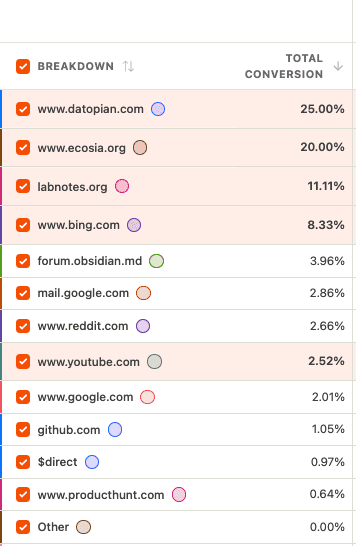
Best-converting referring domains in the current breakdown
www.datopian.com— 25.00% ???www.ecosia.org— 20.00% (search engine)labnotes.org— 11.11% (someone's blog)www.bing.com— 8.33% (search engine)
Interpretation
These sources appear to send higher-intent visitors than the big-volume sources. That likely means these users arrive with better context, stronger relevance, or clearer motivation.
Important caveat
These percentages are likely based on relatively small volumes for some domains, so they should be treated as directional, not definitive. For example, a source can look excellent in conversion terms while still contributing only a handful of actual signups.
What this suggests
- Not all traffic is equal.
- Search/community/referral sources with stronger intent may be worth more than broad awareness traffic.
- Flowershow should optimize for qualified traffic and not just traffic volume.
5. Retention: do users come back?
https://eu.posthog.com/project/85675/insights/RpPqCfdS
Active User Action performed once and then within the next months:
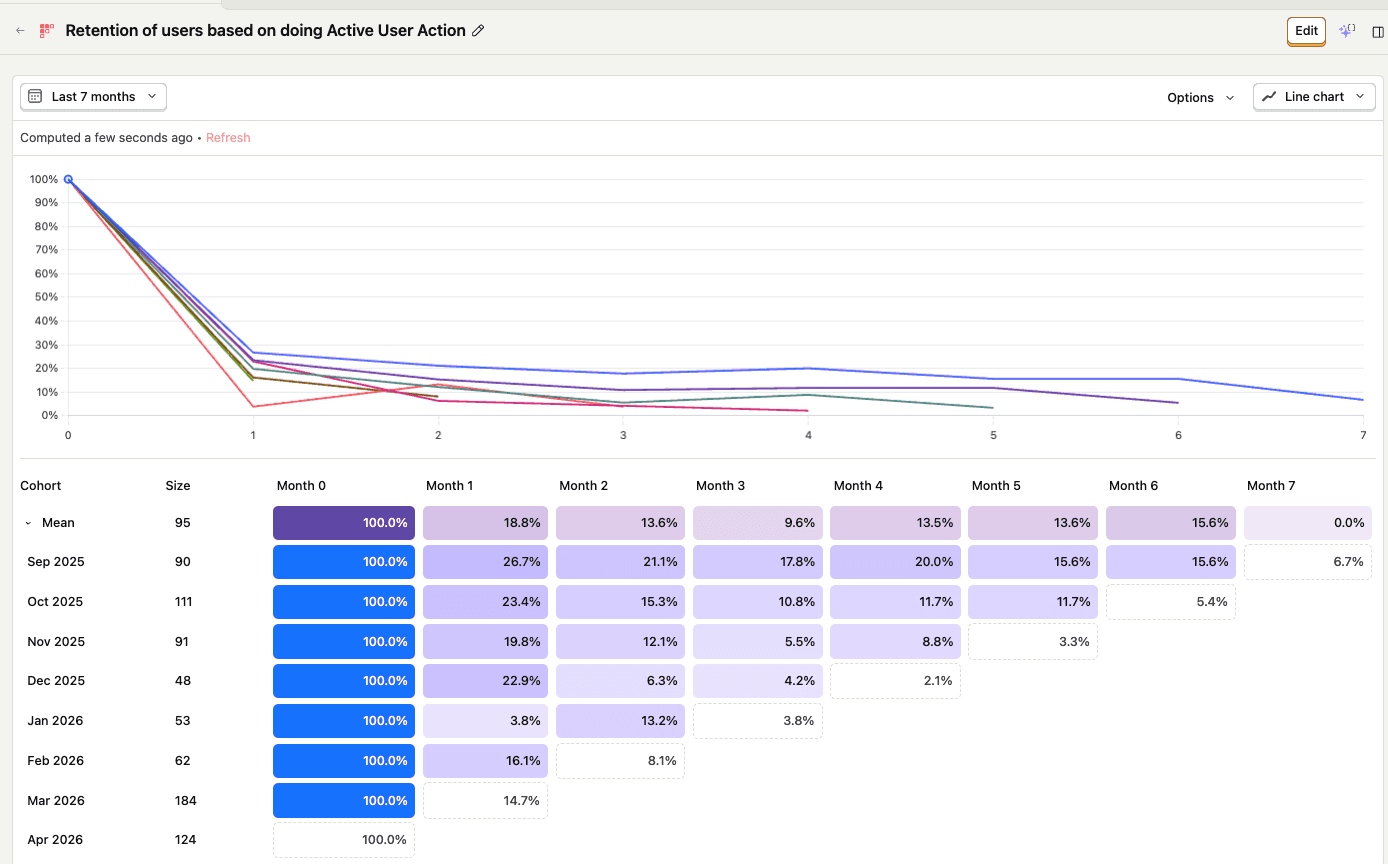
This is a first-time retention chart, tracking users who performed the Active User Action for the first time in a given month, and then checking what percentage came back to do it again in subsequent months.
Key takeaways
- Retention is a problem – the product loses most newly active users within the first month.
- Mean Month 1 retention is 18.8%, and mean Month 2 retention is 13.6%.
- There is no clearly sticky cohort yet that keeps a large share of users active month after month.
- The strongest visible cohort is Sep 2025, with comparatively better retention through later months, but even that group declines substantially over time.
- March 2026 brought a much larger cohort of newly active users, but it is still too early to judge whether they will retain well.
Retention summary
What seems to be happening
- Flowershow can get users to first value.
- It is much weaker at becoming part of a repeated workflow for many of them.
- This suggests the product is currently stronger as a publish once / try once / occasional use tool than as a habit product.
Possible reasons
- Some users only need Flowershow for a one-off publishing task.
- Users may publish successfully once, but do not yet have a strong reason, reminder, or workflow to come back.
- Some acquisition channels may bring curiosity-driven traffic rather than users with an ongoing publishing need.
What this means The main product risk is not only conversion; it is also that too few new active users turn into recurring active users.
6. What workflows are actually used
Current publishing methods:
- GitHub sync
- Obsidian plugin
- CLI
- Drag n drop (authenticated, in dashboard)
- Anon drag n drop (non authenticated)
Publishing method usage
Last 30 days:
- Obsidian: 43.3%
- Drag n' drop (dashboard): 31.7%
- GitHub: 18.3%
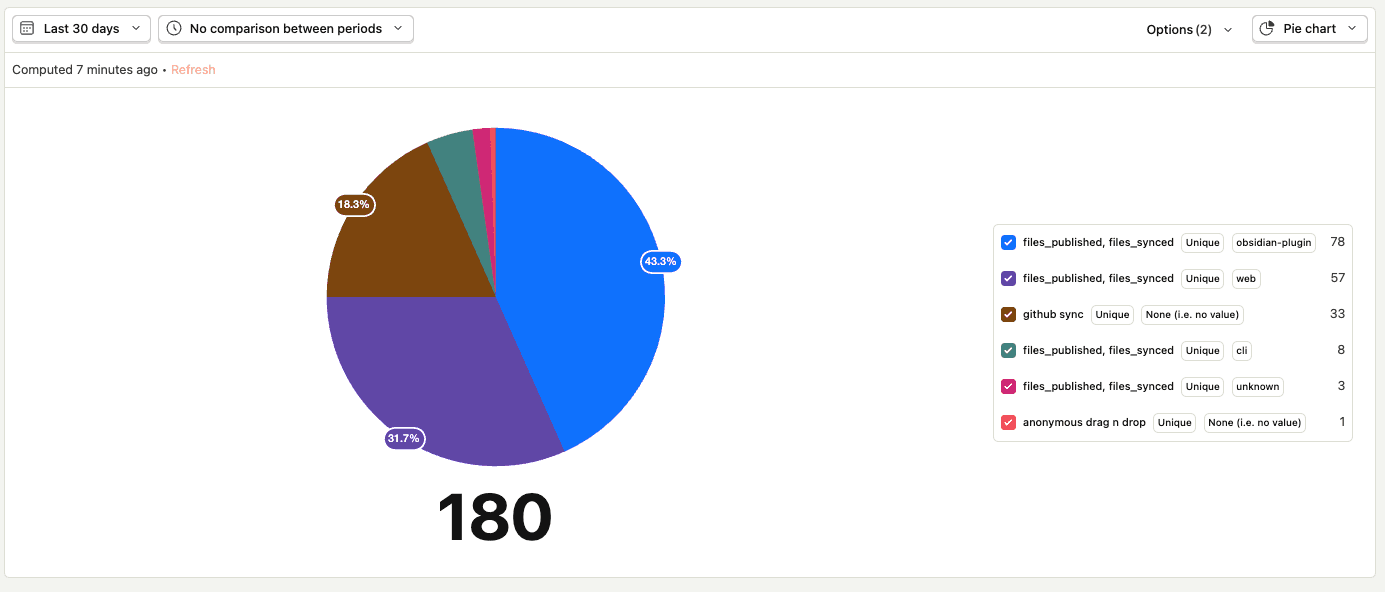
The green part with "Unknown" client type comes from outdated versions of Obsidian plugin (or possibly CLI) that didn't have tracking set up properly.
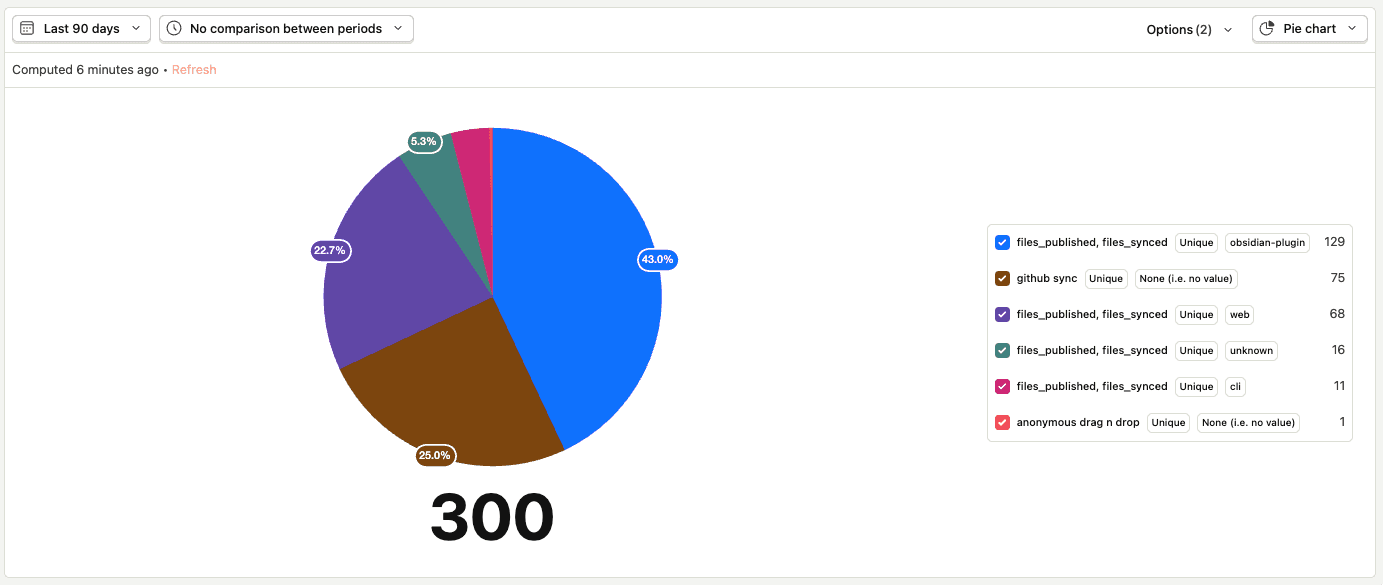
Last 90 days:
- Obsidian: 43.0%
- GitHub: 25.0%
- Web / dashboard upload: 22.7%
- Unknown: 5.3%
- CLI: 3.7%
- Anonymous drag n drop: 0.3%
Last 180 days:
- GitHub: 51.6%
- Obsidian: 27.7%
- Web / dashboard upload: 14.6%
- Unknown: 3.4%
- CLI: 2.4%
- Anonymous drag n drop: 0.2%
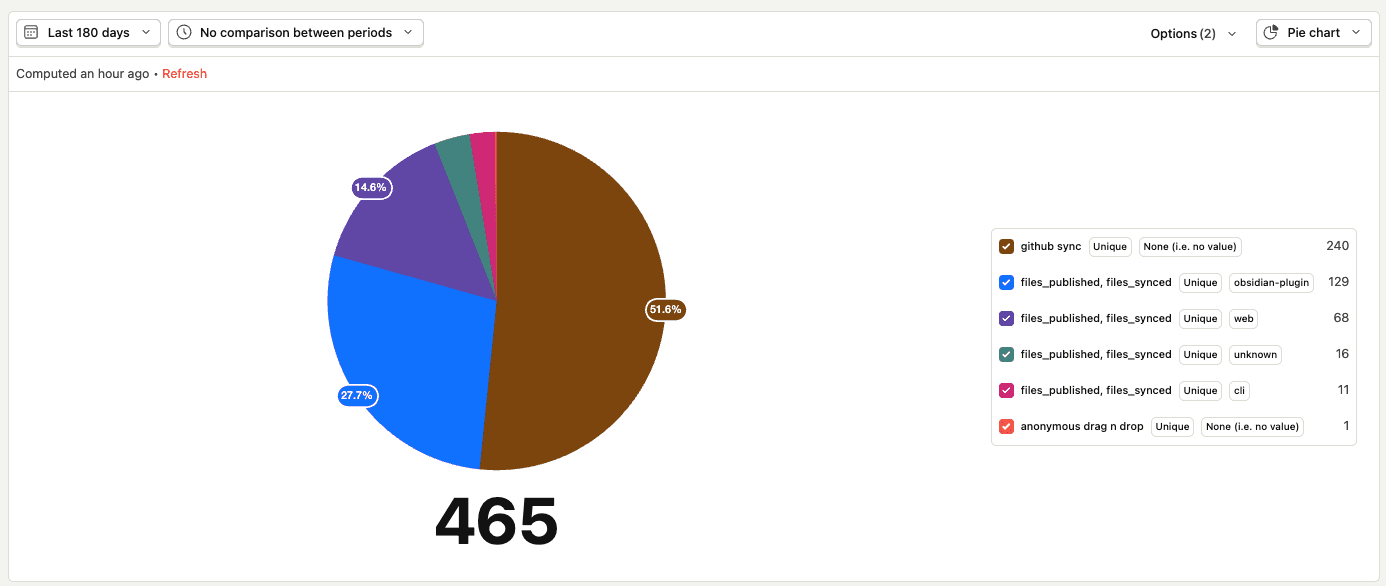
We've added drag n' drop / upload option to the dashboard only recently, and telemetry was added to the Obsidian plugin relatively late too. This explains why GitHub method percentage is so high in longer-window views compared to more recent periods.
Questions
- Which workflows are actually being used?
- Obsidian, GitHub, and direct upload in the dashboard.
- Which workflows are barely used?
- CLI, anonymous drag n drop on
https://flowershow.app/dragndrop.
- CLI, anonymous drag n drop on
- Are we over-investing in low-usage workflows?
- Possibly CLI, at least relative to current adoption.
Workflow summary
Strongest workflows
- Obsidian plugin is now the leading recent workflow.
- Dashboard upload / web publishing has become a major workflow quickly.
- GitHub sync remains important, especially in the longer-term installed base.
Weakest workflows
- CLI usage is very low.
- Anonymous drag and drop is effectively unused.
Interpretation
- Flowershow seems to be strongest where the workflow is easiest and closest to users’ existing habits.
- The product has clear traction with Obsidian users and with simple browser-based publishing.
- More technical workflows still matter, but they do not currently appear to drive most usage.
7. Feature usage
Feature adoption
| Feature | Users who use it | Notes |
|---|---|---|
| Themes | ?? | Not yet measured cleanly |
| Custom CSS | 98 | Strong signal of customization demand |
| Search | 6 | Very low current adoption |
| Comments | 123 | Strongest visible feature adoption |
| Custom domains | 10 | Small absolute number, but relevant because it is a premium-style signal |
| Password protection | 2 | Very low usage |
| RSS | 4 | Support added only recently |
Summary
Most important features based on current usage
- Comments appear to be the most-used measured feature.
- Custom CSS is also clearly meaningful, which suggests users care about control over presentation and branding.
Features with weaker evidence of value
- Search, password protection, and RSS currently show low usage.
- This does not necessarily mean they are unimportant, only that they are not broadly adopted yet.
- Themes remain a gap in the data: they may be important, but the current instrumentation does not answer that.
What this suggests Flowershow’s most evident feature value today is around:
- publishing,
- customization,
- and lightweight audience interaction.
That is more strongly supported than “advanced documentation platform” style feature usage, at least from the current data.
8. Revenue / upgrade signals
| Metric | Value | Notes |
|---|---|---|
| Paid users | 11 | |
| Upgrade rate | 0.0075 (0.75%) | Based on total users |
| Churn / cancellations | ?? | Missing / not yet summarized |
Questions
- Are users willing to pay?
- What seems to drive upgrades?
- Are premium features actually used?
Summary
Current revenue signal
- There is real but still very limited willingness to pay.
- With 11 paid users out of 1499 total users, monetization exists but is still at a very early stage.
- The strongest likely upgrade-related signals in the current data are custom domains, comments, and possibly custom CSS / branding needs, but this is still only an inference.
What the data does and does not say
- It supports that Flowershow already solves a problem well enough for a small number of users to pay.
- It does not yet clearly show which use cases, user segments, or features most reliably drive upgrades.
- It also does not yet show whether premium conversion comes mainly from serious creators, businesses, documentation sites, or personal publishing users.
Bottom line Revenue is a promising signal of product value, but monetization is not yet strong enough to guide strategy on its own. It should still be treated as an emerging signal, not a mature one.
9. What the data seems to show
This section should stay short and evidence-based.
What seems to be working
- Flowershow can attract attention through launches, communities, and search.
- Once users reach signup, the rest of the activation funnel is relatively healthy.
- Obsidian plugin, GitHub sync, and dashboard upload are all real and meaningful workflows.
- Users show clear interest in customization and interaction features, especially comments and custom CSS.
- March 2026 shows that awareness can translate into signups and active users at meaningful scale.
What seems not to be working
- The homepage is not converting enough visitors into signup attempts.
- Retention is weak; most newly active users do not come back consistently.
- CLI and anonymous drag and drop currently have very low usage.
- Attribution is incomplete because a lot of traffic is lumped into direct or other.
What is still unclear because data is missing
- Which exact channels drive the most paid conversions, not just signups or site creation.
- Which feature usage patterns are most associated with retention and upgrade.
- How much of March’s growth will persist versus fade as launch traffic cools.
- How widely themes are actually used.
10. Key learnings from recent work
| Initiative | What was the goal? | What happened in the data? | Takeaway |
|---|---|---|---|
| Anonymous Drag and drop | Increase user conversion | Almost nobody used it | Removing friction alone did not make this a meaningful acquisition or activation path. Either demand is weak or the surface is not where the right users are. |
| CLI | Cover a specific use case / niche | Very low usage relative to other workflows | Useful as a niche capability, but not currently a main driver of product adoption. It should probably not be treated as a top-level growth bet right now. |
| Obsidian plugin | Serve Obsidian users directly | Clearly high and growing usage; strongest workflow in recent periods | This is one of the clearest product-market fit signals. Obsidian is not just a side integration; it is one of Flowershow’s core entry points. |
| Dashboard upload / web publishing | Make publishing easier without GitHub | Grew quickly and is already a major workflow | Simplicity matters. Reducing setup and technical overhead appears to unlock broader usage. |
| Product Hunt launch | Increase product awareness | Huge spike in homepage views, signups, and MAU | Launches and distribution pushes can work very well for awareness. The next question is how much of that traffic turns into retained users. |
11. Main conclusions
Current assessment
- Flowershow is clearly able to attract interest, especially through launches, search, and community channels.
- The core product experience after signup looks meaningfully stronger than the marketing-site conversion before signup.
- Obsidian, GitHub, and simple web upload are the workflows that matter most.
- Retention is the weakest part of the product story right now.
- There are early monetization signals, but revenue is still too small to anchor strategy.
- The strongest recent evidence supports doubling down on easier, higher-intent publishing workflows rather than niche technical paths.
12. Recommended priorities
Keep this short and tied to evidence.
| Priority | Why | Evidence |
|---|---|---|
| 1. Improve homepage conversion | This is the biggest bottleneck in the whole funnel | Only ~3.4% of homepage visitors reach signup, while downstream steps convert much better |
| 2. Double down on Obsidian + simple web publishing | These are the clearest signs of real workflow pull | Obsidian is the top recent workflow; dashboard upload has grown quickly |
| 3. Work on retention, not just acquisition | Growth will be fragile if new active users do not return | Month 1 retention averages only 18.8%, with steep dropoff after first use |
